
Your App Has the Wrong User
I almost built the app, but instead built AI Agent tools — they all shipped

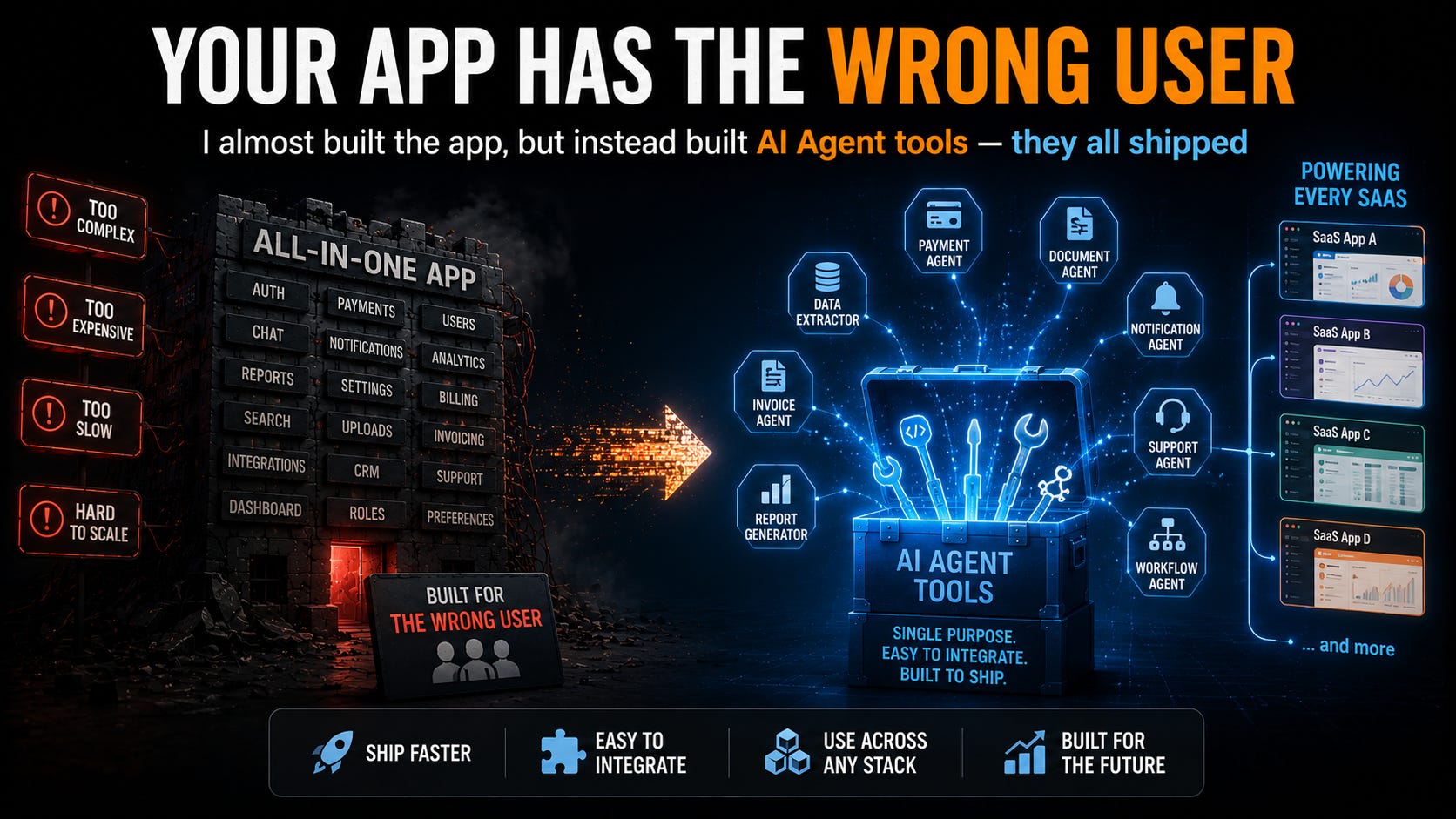
To My AI Amazement
My tasks are in chaos, 3 meetings down, 2 to go, and I’m finishing up an article.
In my head I’m thinking, “I MUST complete editing my video podcast today” and oh boy, did I go down a rabbit hole trying to make the clip automated.
My time was running out but I’m going to stay focus—I’m telling myself,
“finish the article, remember context switching is bad, but maybe, just maybe, it won’t hurt to ask AI, just 1 question, right?”
I chose Codex for this job and watch it “think…”
Watched it gather tools, then execute, more tools, over and over until it was done.
It delivered my clip in 3min.

What’s up, I’m Clint. Built software. Led teams. Now a founder helping builders who are ready to make the leap but can’t quite see the path yet. Every post is one conversation closer to clarity on ownership, execution and momentum.
3 Minutes — I Got Time Then
I got sucked into the trap—the thought of; if you can do this that fast, and had time to install all what you needed, then what about this?
My prompt went something like:
“hey, I have this hour video I have to edit, I typically use CapCut but it really drains my computer, I don’t need a full edit, I just want you to pull a couple clips out, can you do that and how long?
“Ok, I can do that in about 20min”
20 minutes? It took 3.
So, naturally I ask for more to use all of my time;
“Can you also put caption on the clips? What about an end screen? can you cut out the background?”
Sure, CapCut can do this, I don’t even know why I asked. 🤯
“…transcripts? horizontal to vertical? Can you find clips on your own by grabbing the timestamps, best moments, etc…”
10 more minutes pasted, I had 3 scripts.
At my 20 minute mark, I have 6 scripts and wondering,
“Should build an app?”
But then I caught myself—what problem are you solving?
I couldn’t answer, so I stopped.
Who Is Actually Using What You’re Building?
I had one simple problem: provide me a couple autonomous clips from my long form video.
The the “builders trap” caught me. I was trapped and I knew it.
Pondering on how I got here and why some builders like myself, struggle to ship then it hit me.
“Tools”
Everyone is building apps or AI Agents that live within the app—a matter of fact cloud platforms like Claude, Codex, Cursor have build it’s tools and access to them via connectors, MCP, plugins and well just extended capabilities.
And most of them little to no GUI, onboarding, React or hosting.
Just tools doing work.
"What a computer is to me is it's the most remarkable tool that we've ever come up with, and it's the equivalent of a bicycle for our minds." — Steve Jobs
Is The User A Human Or An AI Agent?
That should be the builder’s question…
And if it’s a human, carry on—we know how to build the human interface.
However, if it’s an AI agent, it’s probably smart to build what the agent needs.
Agents don’t need buttons, tooltips, forms, or progressive disclosure. They don’t even need graphic illustrations in their interface—at all.
AI Agents merely need to know how to do one thing reliably.
For the last couple of years, we all have been building, the entire agent infrastructure is already built.
Look at Claude, Codex, Cursor, and Antigravity all support tool and function calling natively—built right into the harness.
They’re RAG-ing knowledge, from everywhere including MCP which had 3,000+ published servers in its first 6 months. Developer adoption of AI agent frameworks grew 400% year over year in 2025.
Google then released A2A then CLI in Google Workspace, Notion, and Microsoft 365 all released AI Agent tools.
We’re here building multi-featured apps of all kind that get killed on the next Claude or Codex feature iteration.
The speed to build gap is closing, but that speed hasn’t been able to transfer into ROI—so, we all get forced to choose our favorite AI platform to build on top of.
Not a bad idea—but as builders, I’m sure we don’t want to be stuck into one. 😊
Look, these are clear early signals, you can see it without me spelling it out, all of big tech is not waiting, clearly, they’re already on the path to building AI tool capabilities with their tool offering.
Why not you?
Progressive disclosure is an interaction design technique that sequences information and actions across several screens or steps. Instead of overwhelming the user by showing everything at once, the interface displays only the most essential information or core features upfront, revealing more complex or secondary options only when the user requests them.
RAG (Retrieval-Augmented Generation): Enhancing an AI model’s output by retrieving factual information from external databases to provide context before it generates a response.
MCP (Model Context Protocol): An open standard that enables AI models to securely connect to and interact with external data sources and local development tools.
A2A (Agent-to-Agent): Autonomous AI agents communicating and collaborating directly with one another through shared tools or APIs to execute complex tasks.
CLI (Command-Line Interface): A text-based user interface where users interact with a computer’s operating system or software by typing specific text commands.
The Agent Is The Computer
We’ve already seen Anthropic’s & OpenAI’s Computer Use (Operator) features.
It can do some really powerful things, such as navigating your browser windows and desktop apps—even with apps supporting AI cloud platforms.
These computers need tools to be efficient and reliable.
Every time an AI agent clicks a button instead of calling a tool, you’re just throwing away tokens—it’s all wasted, due to the 10–100x the compute cost of a direct function call.
If you can reliably solve one problem by enabling an agent, you’re set for the future.
Don’t build the next TikTok for builders.
Build the most used tools by TikTok—because TikTok uses AI. 😁
“Do one thing well — Unix, 1978.”
I Think I’ll Focus On Building More CLI and Scripts
My autonomous clip generation adventure, proves to me all we need to build is tools, give the AI agent a goal and GO!
Prompt: “here, the file [path] to the full mp4. transcript (optional). Get me the best clips for my brand.”
My AI Agent CLI Tools
STT Transcription: Use Whisper to generate a timestamped transcript.
Clip Discovery: Analyze transcript.txt to identify viral segments with specific start/stop times.
Clip Editing: Remove original backgrounds, composite new ones, and optimize render settings.
16:9 to 9:16: Convert horizontal footage to vertical format using smart cropping/re-framing.
Element Overlay: Burn in dynamic captions and attach a branded end screen.
Batch Processing: Automate the full pipeline to process all identified clips in a single queue.
I orchestrated this with prompts, skills and tools references—note, agents like Codex also knows how to use it’s platform to complete all of this already and surely, it’s through the use of AI tools at the AI Agent fingertips.
Tools For AI Agents — But For Who, Though?
Processes in an organization hasn’t mature enough to alter SOPs and augmented AI Solutions. They’re either taking what Claude, Codex & Co-Pilot give them or hacking their way through it—due to no governing structure for AI implementation.
But as builders, small businesses have simple issues we can fix—start with a good prompt then a simple agent, as time evolves this agent will need more capabilities—tools.
But you can’t sell AI tools and CLI to small businesses! True, to them it’s all an “app” but to you it’s an AI Agent tool—start there.
Build a solution using AI + CLI + tools—this is the arms—optional interface, if they insists for admin or dashboard.
Done.
Before the popularity of AI, we started building by designing the GUI first, but now, if we can focus on the AI tools first, the interface writes its own spec once the tools exists.
SaaS is being unbundled—not dying, I think. Things like project management, CRM, and communication operations, will always be exactly here, where AI agents are most capable.
Tools will expire, coupled with an AI Agent orchestrator it can evolve.
Behind the Build: This is my story—the ‘What’ and ‘Why.’ If you are a builder who needs the ‘How,’ I have documented the technical architecture, AI prompts, and logic for this specific solve in the Technical Log.
Look At The Pie — Pick A Slice
A real solvable problem and start with the simplest approach.
A skill + a script (Claude can build) + a Cron—a scheduled task—solve 1 thing.
These online big wigs models won’t build a tool that monitors your specific website’s logs and texts you when something breaks—I will, ha.
The smaller the tool, the smaller the risk.
The faster it ships, the faster you learn—facts!
A badly built tool is recoverable in a day—a day, not 3 weeks of human UI feedback before you find out the core function was wrong.
One Agent
One tool.
One Function That Does One Thing Well
A simple flow;
Your agent uses the tool, you find the gaps, then you build the next one.
The portfolio and each AI tool grows into a full capability.
Shipped
I almost built an app but instead built a series of tools that I now use along with my Claude and Codex.
Happy Building—AI Tools.
What are you building?
Research
“The Model Context Protocol” — Standardizing model-to-data connections.
Stack Overflow Developer Survey 2025 — 2025 developer trends.
Google A2A Protocol — Agent-to-agent communication framework.
OpenAI Operator — Computer-using autonomous agent.
LangChain — LLM application framework.
CrewAI — Multi-agent orchestration platform.
AutoGen — Conversational multi-agent systems.
Unix philosophy — Modular, interoperable tool design.
Stripe API-first — Financial infrastructure via API.
Twilio developer-first — Communication building blocks.
a16z — AI-driven service economy.
Hey Clint nice work